
Energy and Climate Change | Proposed amendments to the Norwegian CO₂ Storage Regulation
The proposals include the assessment of a dedicated CO₂ Storage Act, the introduction of a single exploitation licence covering the exploration, development and operational phases, proposed flexibility on the corporate organisation of licence-holding activities, and the introduction of dedicated rules to safeguard national security interests, among other matters.
The proposed amendments to the CO₂ Storage Regulation are of key relevance for companies with existing or planned positions in the CO₂ storage market on the NCS.

BACKGROUND
The NCS holds significant geological potential for CO₂ storage across a range of formations, and Norway has over 30 years of experience with safe and reliable CO₂ storage through its petroleum activities. This positions Norway well to support large-scale, commercial CO₂ storage, and a key element of the Norwegian Government’s climate strategy is accordingly to facilitate such storage as a cost-effective means of achieving climate targets.
A key element of that strategy is to facilitate large-scale, commercial CO₂ storage on the NCS for CO₂ volumes captured in other European countries. By making Norwegian storage capacity available to companies seeking to offer CO₂ storage as a commercial service to European emitters, Norway supports the role of CO₂ storage as an important climate solution for European countries in meeting their climate targets. Developing storage capacity is, however, contingent on a sufficient number of customers committing adequate financial resources to make investment in storage infrastructure commercially viable for storage operators.
CO₂ management remains at an early stage of development, and the development of a market for CO₂ storage is dependent on the establishment of value chains and the supporting infrastructure. Due to Norway’s industrial structure and energy supply mix, the domestic potential for CO₂ storage is relatively limited, meaning that cost-effective CO₂ storage on the NCS cannot be established without a substantial contribution from customers supplying CO₂ from other countries in Europe.
Against this backdrop, the MoE has identified a need to maintain investor incentives for the establishment of storage and transport solutions, so as to enable CO₂ storage value chains to be realised in accordance with the Norwegian Government’s climate objectives. In this regard, the MoE considers that facilitating commercial flexibility within the existing regulatory framework may contribute to sustaining those incentives – and it is this objective that underpins the proposed amendments to the CO₂ Storage Regulation.
The principal proposals put forward by the MoE are set out below. Further details are available in the MoE’s consultation here. The consultation period closes on 5 June 2026.
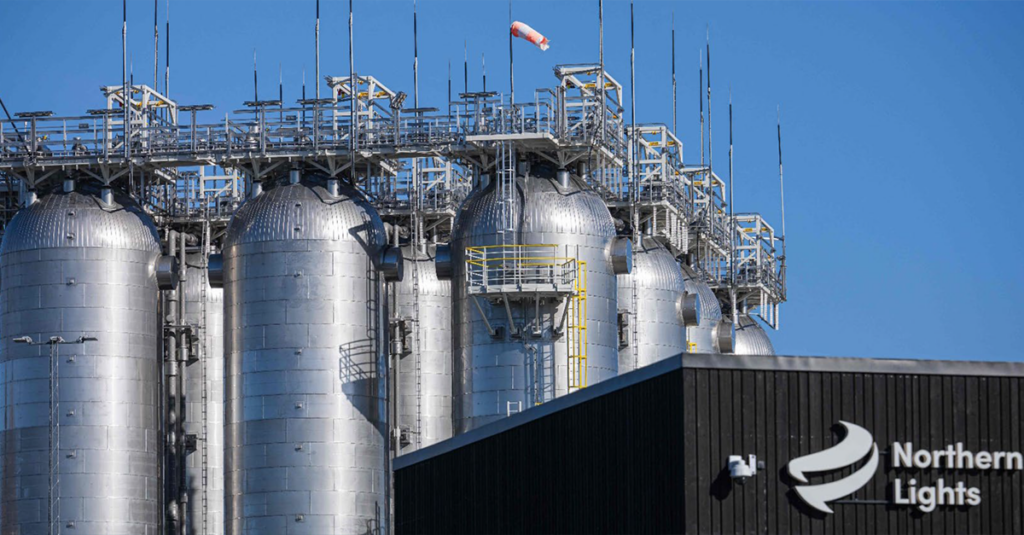
CO₂ transport and storage facility operated by Northern Lights at Øygarden. Photo: Jonathan Nackstrand, AFP.
THE PRINCIPAL PROPOSALS
- Dedicated CO₂ Storage Act
The CO₂ Storage Regulation is currently based on the Act of 21 June 1963 No. 12 on scientific research and exploration and exploitation of submarine natural resources other than petroleum and mineral deposits (“1963 Act”) – a framework statute that the MoE considers an inadequate foundation for the detailed regulation of future CO₂ storage activities on the NCS. The MoE has therefore initiated an assessment of whether a dedicated CO₂ Storage Act should be developed to replace the 1963 Act as the legislative basis for the CO₂ Storage Regulation.
It should be noted that, from a commercial standpoint, the question of whether exploitation licences may be pledged as security for project financing is of particular relevance. The industry has consistently raised this as a prerequisite for securing debt financing for CO₂ storage projects on commercially acceptable terms. As pledging a licence requires a statutory basis, the MoE intends – as part of its broader assessment of a dedicated CO₂ Storage Act – to consider introducing pledge provisions in such an Act equivalent to those currently found in Chapter 6 of the Petroleum Act.
- New Licensing Structure: One Licence Covering the Exploration, Development and Operational Phases
The most structurally notable change proposed is the simplification of the licensing regime by replacing the current two-step system – under which a company must first obtain an exploration licence and subsequently apply for a separate exploitation licence – with a single exploitation licence covering the exploration, development and operational phases.
The change has been actively encouraged by the industry, which has identified the current two-step process as an obstacle to securing customer contracts and financing on commercially acceptable terms. It is emphasised, however, that this change does not represent any real change to the MoE’s award policy to date.
Under the proposed new framework, a single exploitation licence will be granted for a duration fixed at the time of award of the license, subject to a work programme with defined milestones at which the licence holder must decide either to proceed to the next phase or to relinquish the licence. The licence duration will not be limited to the work programme period – it is intended to also cover any subsequent development and operational phases, with the aim of supporting an industrial maturation process for CO₂ storage projects. The final milestone in the work programme will typically be the investment decision and submission of an application for approval of a development and operations plan, or relinquishment of the licence.
Shortly after the amendments enter into force, the MoE will issue individual administrative decisions converting existing exploration licences into exploitation licences, with the necessary adjustments to the completed and uncompleted parts of the work programme and the licence term.
- Corporate Organisation of CO₂ Storage Activities
Under the current CO₂ Storage Regulation, activities conducted pursuant to licences granted to several legal persons jointly must be carried out for the participants’ joint account and risk. This triggers the application of the Norwegian Partnership Act, and the MoE has required such activities to be conducted through a general partnership (Nw: “ansvarlig selskap”).
Following a reassessment, the MoE seem to be of the view that it may be more appropriate to allow participants in CO₂ storage activities to choose their own organisational form freely, as is ordinarily the case in other commercial activities.
An alternative to free choice of organisational form would be to require CO₂ storage activities to be organised through a statutory unincorporated joint venture model (Nw: “interessentskap”), along the lines of the petroleum sector. The MoE put forward such a proposal in a consultation paper in April 2022, under which participation in cooperation agreements for utilisation licences would be structured as a separate unincorporated joint venture, granted a specific exemption from the Norwegian Partnership Act pursuant to Section 1-1 (4) of that Act. However, this proposal was ultimately not adopted.
In the consultation, the MoE considers it valuable to examine the advantages and disadvantages of implementing more flexibility in relation to the structuring of CO₂ storage activities on the NCS, including what conditions would need to be in place for an unincorporated joint venture model to function effectively for licence holders, authorities, and third parties.
Therefore, the MoE is inviting consultees to comment on whether there should be a free choice of organisational form for participants in licences under the CO₂ Storage Regulation – as for ordinary commercial activities – or whether, as in the petroleum sector, activities should be required to be organised through a statutory unincorporated joint venture model.

- Criteria for Award of Licences
Under the current CO₂ Storage Regulation, a licence may only be granted to an applicant with the financial strength, technical competence and reliability required to operate and control a CO₂ storage site.
However, the CO₂ Storage Regulation do not clearly set out the criteria to be applied when deciding between competing applicants for a licence within a specific geographic area. The MoE proposes to amend the CO₂ Storage Regulation in order to clarify the criteria that will be applied when awarding exploitation licences.
It is proposed that an exploitation licence shall be awarded on the basis of objective and non-discriminatory criteria, including the applicant’s geological and technical competence and understanding, relevant industrial experience, financial capacity, business plans for the area, and proposals for exploration activity and work programmes for the area covered by the application, as well as any other criteria set out in the announcement, so as to promote the best possible resource management.
Furthermore, the MoE also invites consultees to comment on whether the current requirement – that all participants in a jointly held licence must individually satisfy the qualification criteria – should be maintained, or whether a more differentiated approach may be appropriate for CO₂ storage and transport activities.
- Corporate Agreements
The consultation paper proposes to clarify that the MoE may impose conditions requiring licence holders to ensure that agreements between their owners – such as shareholder agreements or cooperation agreements – are consistent with standard cooperation agreements drawn up by the MoE.
The aim is to prevent decision-making mechanisms agreed between owners from obstructing decisions that would otherwise be rational from a resource management perspective – for instance, unanimity requirements that could block necessary progress in licences held by multiple participants.
- New rules increasing authority power to safeguard national security interests
The consultation paper proposes that an explicit authority be introduced in the CO₂ Storage Regulation to refuse the grant of a licence, and separately to revoke an existing one, on national security grounds.
The power to revoke would be vested in the King in Council (Nw: “Kongen i statsråd”) and is framed as a safety valve – a backstop mechanism to ensure that national security interests are not compromised as a consequence of licence awards under the CO₂ Storage Regulation. In addition, the proposals would extend the existing revocation provision to also cover the amendment of licences, providing the MoE with a more graduated set of tools for situations where outright revocation may not be the most appropriate response.
The proposed provisions mirror comparable mechanisms already in place under the Seabed Minerals Act, reflecting a view that the considerations relevant to that sector apply with equal force to CO₂ storage activities. No specific criteria for invoking the national security powers are set out in the consultation paper; the scope of the provisions will therefore be shaped in practice over time.
- Development of CO₂ Transport Infrastructure
The consultation paper proposes a new provision authorising the MoE to designate a body to assess the development of CO₂ transport infrastructure on the NCS – including connection points for CO₂ storage sites – with a view to achieving coherent, system-wide transport solutions for CO₂ capture and storage activities.
Gassco is the entity envisaged for this role, in line with earlier communication from the MoE setting out Gassco’s function in evaluating CO₂ transport solutions.
The underlying rationale is that well-coordinated transport infrastructure is an important instrument for ensuring the economically efficient management of CO₂ storage capacity on the NCS. In the event a proposed transport solution is relevant to multiple storage licences, the MoE may require independent system-wide assessments before granting development approvals – a function that Gassco has in practice already been performing in connection with several projects in recent years.
- Insurance Requirements
The consultation paper clarifies that the insurance requirement is a standalone obligation, independent of the separate requirement to maintain a financial security instrument.
However, the MoE does note that this strict separation may not be permanent and indicates that, should the insurance market for CO₂ storage activities develop sufficiently, it is conceivable that an insurance arrangement could also serve as an element of a financial security instrument. Whether a particular policy would be adequate for that dual purpose would need to be assessed on a case-by-case basis. One key condition would be that the insurance must confer a direct benefit on the Norwegian State, placing it on the same footing as other instruments used for financial security purposes.

BAHR’S VIEW
The proposed amendments represent a modernisation and further development of the regulatory framework governing CO₂ storage activities on the NCS. If implemented, the changes will enhance predictability and create more flexibility in the structuring of CO₂ storage activities on the NCS.
The proposals are not fundamental reforms, but rather practical refinements – informed by the experience gained since the CO₂ Storage Regulation entered into force and by feedback received from the companies operating in the sector.
The overarching aim of the amendments is to simplify and streamline the existing framework in order to reduce administrative complexity and improve efficiency for licence holders. The introduction of a single exploitation licence is a good example of this approach: it does not alter the substantive rights and obligations of licence holders, but removes an administrative step that has been identified as unnecessarily burdensome in practice – particularly in the context of securing long-term customer contracts and project financing. Furthermore, the proposed move towards a free-choice model for corporate organisation is similarly motivated by a desire to give companies greater operational flexibility, though the question of which organisational model is best suited to CO₂ storage activities remains a live one, and the MoE has explicitly invited input on this point.
Several questions of broader commercial and legislative significance remain open following this consultation. The question of pledge rights over exploitation licences, and more generally the question of whether a dedicated CO₂ Storage Act should be introduced, will require further legislative consideration, and will be of continued interest to licence holders, lenders, and other market participants. The responses to this consultation are likely to play a key role in shaping the MoE’s further work in this area. Any amendments to these provisions, coupled with greater certainty around financial security requirements, stand to have a material impact on both existing and prospective licence holders.
BAHR is monitoring and actively taking part in the shaping of the regulatory framework for CO₂ storage activities on the NCS. Should you have any questions, please do not hesitate to contact a member of BAHR’s CCS team.