
Asset management | ESG & compliance | SFDR 2.0: summer 2026 update – and a potential opt-out for professional investor AIFs
As negotiations between the co-legislators in the EU approach, this update sets out the proposed changes, where the institutions agree, where the outcome remains open and what fund managers should be doing now in respect of new fund launches and fundraisings.

Background
SFDR has been in force since 2021. The comprehensive disclosure and reporting burdens have been heavily criticised. Additionally, the Article 8 and Article 9 categories it introduced became de facto market labels, despite being designed purely as disclosure categories. The result has been inconsistent practice across managers and products and confusion among managers and investors alike. SFDR 2.0 is the response: a simplification of the disclosure framework and the introduction of a genuine product categorisation regime with substantive portfolio composition requirements, replacing the Article 8 and Article 9 regime.
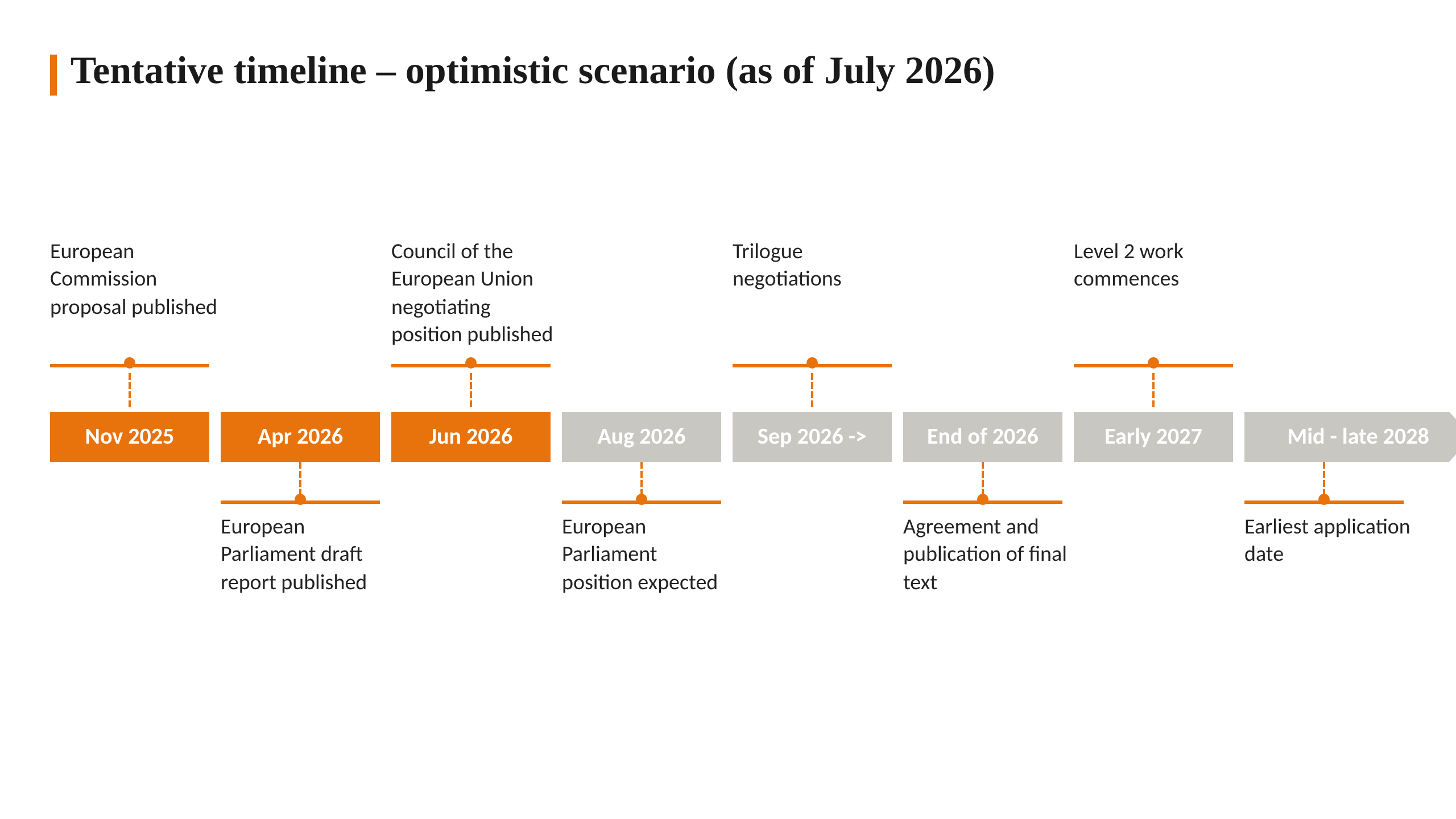
Formal negotiations between the EU institutions are expected to start in September 2026.
One of the most significant developments from the Council’s position (and not part of the Commission’s original proposal) is a proposed opt-out from the SFDR 2.0 categorisation regime for alternative investment funds (AIFs) marketed exclusively to professional investors. For managers in private equity, venture, infrastructure, real estate and other alternative strategies aimed at professional investors, this could, if adopted, fundamentally change how the new regime applies to them.
What is being proposed
New product categories
The Commission proposes replacing Article 8 and Article 9 with three defined product categories, each carrying substantive portfolio composition requirements. The following seems broadly agreed between the European Commission, the Council and the Parliament:
- A three-category system (ESG Basics, Transition and Sustainable) replacing Article 8 and Article 9. Products that do not elect a category (non-categorised products) may still include ancillary sustainability information, but must carry a mandatory disclaimer making clear they do not meet EU criteria for a sustainability-related product.
- A 70% portfolio threshold, requiring at least 70% of a product’s investments to meet the portfolio composition criteria of its chosen category. The remaining 30% may be used for hedging, diversification, or liquidity, provided it does not contradict the product’s sustainability claim.
- Mandatory exclusions across all three categories, with the restrictions becoming more stringent as the categories progress from ESG Basics to Transition to Sustainable.
- A “with impact” sub-label is proposed under the Transition and Sustainable categories for products that pursue a predefined, positive and measurable environmental or social impact objective. Use of the word “impact” in product names or marketing is otherwise restricted.
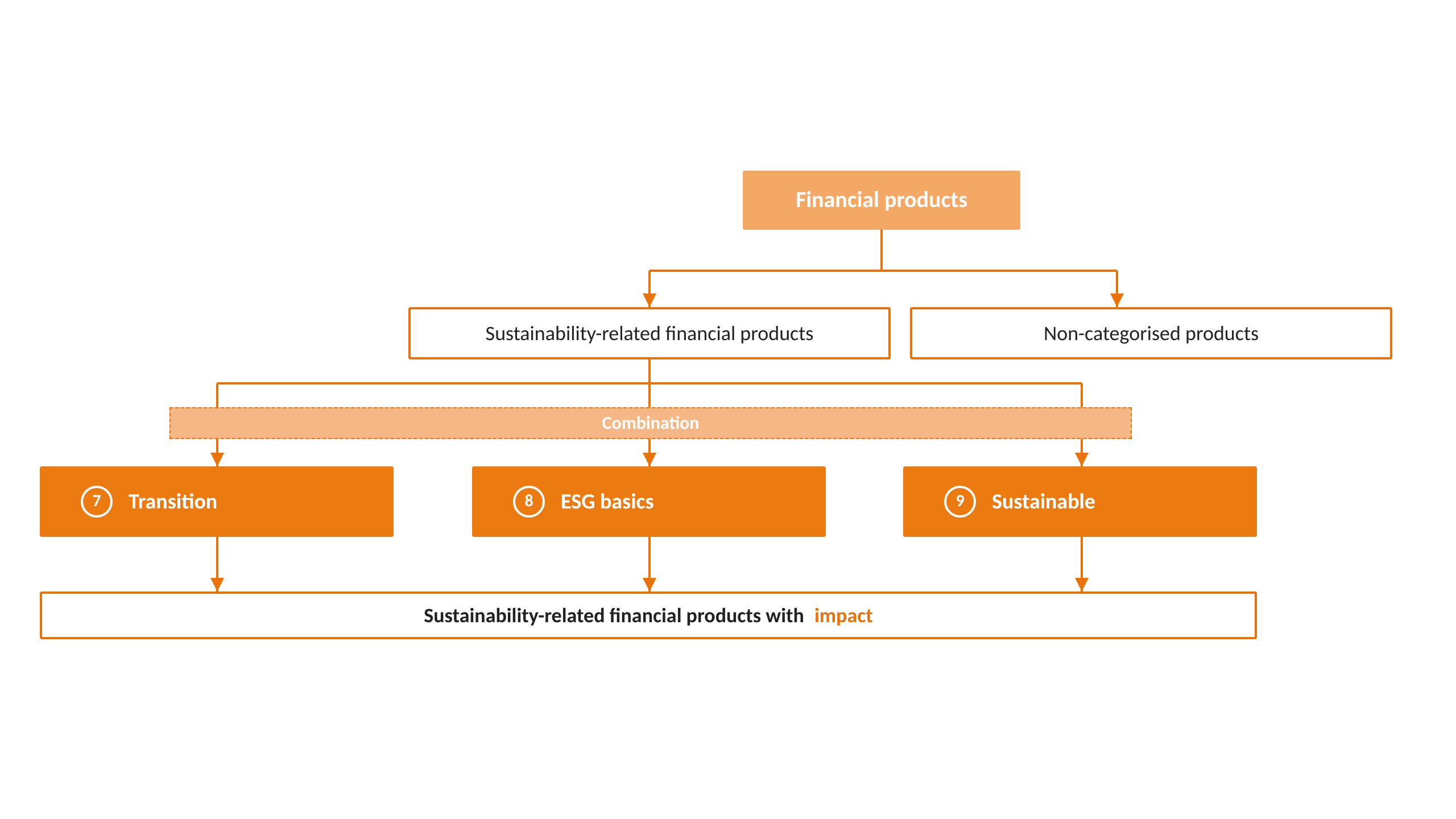
- ESG Basics is intended as the broad entry point for products that integrate ESG considerations into their investment process without committing to a full sustainability or transition objective. At least 70% of the portfolio must meet an ESG-based sustainability claim (for instance, outperforming a relevant peer group by reference to ESG criteria after applying exclusions). No mandatory principal adverse impact (PAI) identification is required.
- Transition is designed for products investing in companies or assets on a credible path towards sustainability, for example, businesses with science-based emissions reduction targets or documented transition plans. At least 70% of the portfolio must be directed towards assets contributing to an environmental or social transition, and managers must identify and disclose PAIs.
- Sustainable is the most demanding category, reserved for products with a genuine and demonstrable sustainability objective. At least 70% of the portfolio must meet defined sustainability criteria, including avoidance of significant harm to other environmental or social factors. PAI identification and disclosure is required.
The “sustainable investment” definition in existing SFDR (Article 2(17)) is deleted, with the ‘sustainable investment’ concept embedded into the category criteria. References to the concept of ‘sustainable investment’ will going forward primarily refer to the EU Taxonomy framework.
Tailoring to private assets (unlisted equity, real estate, infrastructure etc.)
The Council’s position includes two provisions that reflect a welcome recognition that private assets, including unlisted equity and debt, real estate and infrastructure, have structural characteristics that distinguish them from listed securities. First, a phase-in mechanism of up to three years is proposed for reaching the portfolio composition threshold, acknowledging the longer deployment timelines inherent in illiquid strategies. Second, it is proposed that compliance with the portfolio composition requirements for private assets can be demonstrated through documented, asset-class-appropriate evidence and methodologies and, where relevant, a proven positive track record. The methodologies used must be described and disclosed.
Removal of entity-level obligations
SFDR 2.0 removes two existing entity-level disclosure obligations that many managers have found burdensome: the requirement to publish a statement on how investment decisions take account of principal adverse impacts at firm level (which includes mandatory reporting on a number of KPIs), and the requirement to disclose how remuneration policies align with the integration of sustainability risks. Both are proposed deleted in their entirety.
Exclusion of investment advisers from scope
It is proposed that investment advisers are excluded from SFDR altogether.
Implications for closed funds
Both the Commission and the Council agree that an opt-out should be available for closed-ended products that are closed to new investors and will no longer be offered to investors after the application date of SFDR 2.0. This is a proportionality measure aimed at avoiding the burden of restating or relabelling products that are already past their fundraising period.
Open questions to watch going forward
Negotiations between the EU institutions have not yet formally begun, and a number of substantive points remain open. Several are likely to have a significant effect on asset managers in practice. BAHR follows these developments closely and will continue to issue updates as the discussions progress. Developments at the EU level ahead of a final legislative text can be directly relevant for alternative investment fund managers with long fundraising periods and long investment horizons.
Below is a brief overview of some of the main issues still outstanding and where we expect further clarity during H2 2026:
Professional investor AIF opt-out. One of the most significant discussion points is the Council’s proposal that managers should be able to elect not to apply the categorisation regime to AIFs marketed exclusively to professional investors. The rationale is that investor protection considerations are materially reduced in that context.
Implementation timeline. Whether the transition period will be 18 or 24 months from publication of the final text is not yet determined. In practice, additional delegated acts (Level 2 rules) must be adopted by the Commission before the new regime can take effect, leaving managers with less preparation time than the dates alone may imply.
Fund category criteria and exclusion requirements. The precise conditions for qualifying under each category are still being negotiated, including which exclusions that should apply to which category. The calibration of the ESG Basics category in particular – including the methodology for demonstrating outperformance against a relevant peer group or benchmark – is likely to be relevant to many asset managers but is still not yet finalised.
Tailoring to illiquid strategies. The proposed phase-in mechanism and asset-class appropriate compliance requirements for the 70% threshold applicable to the portfolio composition for all three proposed fund categories is highly relevant for alternative strategies such as private equity, venture, real estate and infrastructure. The maximum permitted duration of a phase-in and how illiquid products can demonstrate compliance with the portfolio composition requirements are expected to be negotiated further. The Council proposed capping the phase-in at three years.
PAI framework. All institutions agree that Transition and Sustainable products must identify and disclose PAIs. What remains open is how much standardisation is imposed: the proposals range from a flexible, manager-defined approach, to a requirement to use at least a minimum number of indicators from a future regulatory list, to mandatory indicators specified directly in the text. This will determine both how comparable disclosures are across the market and how much operational flexibility managers retain.
Practical considerations for fund managers
Timing of fund establishment and fundraising. The key question for most managers is whether a new fund will close before or after SFDR 2.0 applies, currently expected mid 2028 at the earliest. Funds closing before that date will be established under the current framework. Funds that may still be raising capital when SFDR 2.0 enters into force should plan for a potential transition, including considering which SFDR 2.0 category best fits the fund’s mandate and whether its portfolio composition requirements are achievable. Industry organisations have suggested to the EU legislators that managers should be permitted to voluntarily adopt the new framework ahead of the application date once the final text is published, but this has not yet been taken up by any of the institutions.
Ensure flexibility in fund documents. Managers establishing funds now who anticipate a potential transition to SFDR 2.0 should build flexibility into their fund documents from the start. LPA amendment provisions should be broad enough to accommodate regulatory changes without requiring investor consent. PPMs should address regulatory transition as a risk factor, and sustainability-related commitments in side letters and investor communications should be drafted with care. Overly specific language or commitments tied to parts of the current SFDR regime where changes are expected (for example, undertakings pertaining to PAI reporting) can constrain a manager’s ability to adapt as the framework and investor expectations evolve.
On the AIF opt-out: a practical perspective. Whether the opt-out will be adopted remains open, but its importance will likely vary. For managers raising capital from large European institutional investors (pension funds, insurers and sovereign wealth funds) SFDR compliance may be expected regardless of any formal exemption. The opt-out is more likely to deliver meaningful simplification for smaller managers with less sophisticated professional investors, concentrated or bespoke vehicles (co-investments, continuation vehicles, SPVs) and for managers whose investor base is primarily non-EU. In either case, the decision whether to use an opt-out will likely ultimately be driven by investor expectations rather than the regulation itself.